
Society, Architecture, and Cinema / Dincolo de distopie. Societate, Arhitectură și Cinema
Editors / Coordonatori: Nely Vînău, Răzvan Mircea Nica, Tiberiu Teodor-Stanciu
Publisher: Editura Universității Tehnice „Gheorghe Asachi” din Iași, Iași, 2026
ISBN: 978-973-621-579-7
Language: Bilingual (Romanian/English)
About the volume
Dystopian cinema diagnoses the present through hyperbole: it exaggerates tendencies already active in the urban fabric, in housing policy, in the relationship between architecture and society. Utopia and dystopia are not simple opposites but mirror images of one another; dystopia functions as a metaphor for the anxieties of an era, born from the failure of the modernist ideal city to deliver on its own utopian rhetoric.
The volume argues that dystopian film is not a backdrop but a theoretical object in its own right, capable of generating its own analytical categories and revealing dimensions of the built environment that classical architectural criticism tends to overlook. Its four structuring films – Metropolis, A Clockwork Orange, Blade Runner, Blade Runner 2049 – are treated not as illustrations of pre-existing architectural theses but as critical devices, each interrogating a real mechanism: socio-spatial segregation, the failure of modernist utopia, the ideological instrumentalisation of built form, the relationship between technology and dwelling.
The three sections – Architecture and Cinema: Styles, Locations, Stigmatizations; Dystopian Imagination: Theory, Memory, Representation; Tools and Representation: Technology, Design, Image – trace an arc from concrete case toward theory, and from theory toward the instruments through which architecture is imagined and represented. Contributors come from academic contexts in Romania, Austria, and Hong Kong, working across architecture, art and film history, graphic and industrial design, video art, and artificial intelligence — disciplines convened not as labels but as distinct angles of access to a shared object.
The studies gathered here are independent research contributions, developed from the themes, debates, and questions generated across the five annual editions of SF(a) Society. Film. Architecture; they are not conference proceedings.
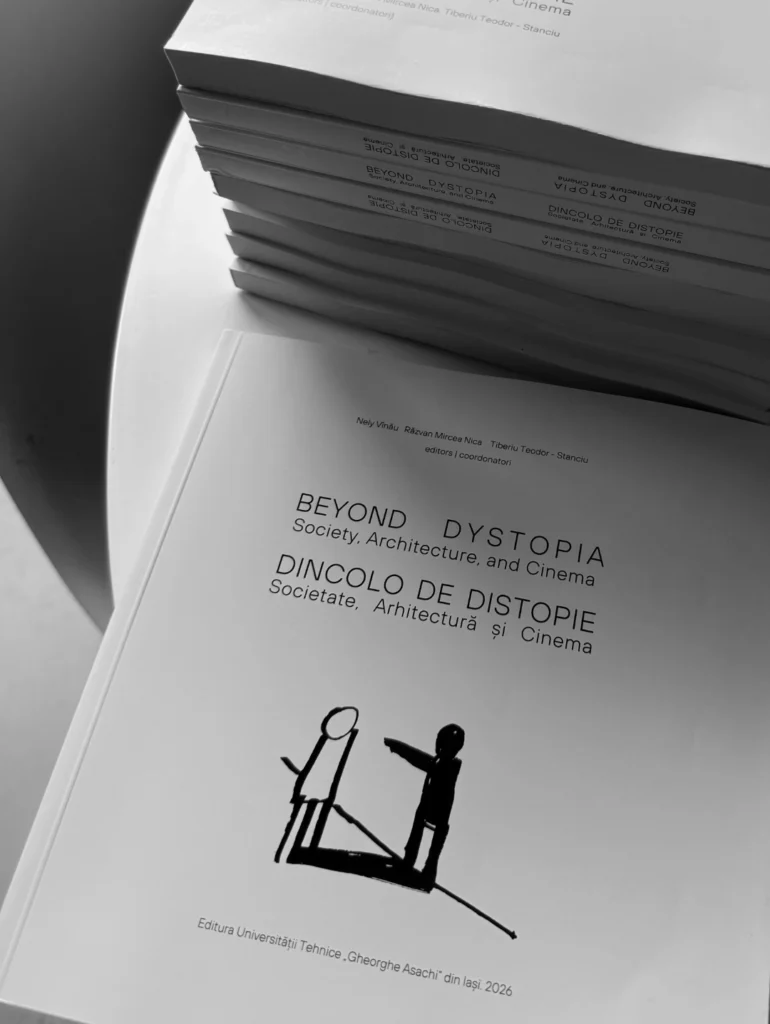
Table of contents / Cuprins
Beyond the Image. Dystopia as a Critical Instrument / Notă editorială — Dincolo de imagine. Distopia ca instrument critic (p. 5)
Section I — Architecture and Cinema: Styles, Locations, Stigmatizations / Arhitectură și cinema: stiluri, situri, stigmatizări
- Nely Vînău — Dystopian Architecture in Cinema: From Lang’s Modernism to Kubrick’s Brutalism (p. 15)
- Viola Rühse — Brutalist Locations in Stanley Kubrick’s A Clockwork Orange (p. 37)
- Răzvan Mircea Nica — British Brutalism and Its Stigmatization: Public Policy, Social Segregation and Dystopian Imagination (p. 59)
- Viola Rühse — Sci-fi Fantasies Shot in Budapest and the Surrounding Area: Hungary as an Ahistorical Film Set Supermarket for Blade Runner 2049 (p. 69)
Section II — Dystopian Imagination: Theory, Memory, Representation / Imaginar distopic: teorie, memorie, reprezentare
- Nely Vînău — Blade Runner and Blade Runner 2049. From Postmodern Pastiche to Hypermodern Simulation (p. 91)
- Ramona Costea — Architectures of Memory. Blade Runner 2049 (p. 115)
- Răzvan Mircea Nica — Architectural Monologue: The Structural Failure of Dialogue from Modernism to Contemporary Practice (p. 133)
- Ana-Cristina Tudora, Florina Pantilimonescu-Cioancă, Gabriel Tudora — The Genesis, Psychology and Ethics of Non-Standard Architecture (p. 147)
Section III — Tools and Representation: Technology, Design, Image / Instrumente și reprezentare: tehnologie, design, imagine
- Silviu Teodor-Stanciu — Reality vs. Fiction in Car Design: Probe 16 vs. Durango 95 (p. 171)
- Silviu Teodor-Stanciu — Dystopian Car Design. Blade Runner 2049 (p. 179)
- Anca-Simona Horvath — Trans-coding Literature to Architecture with Generative AI: From A Clockwork Orange to Conceptual Architectures (p. 187)
- Andrei Cozlac — Augmented Architectural Dimensions in Relation to Video Art and Videomapping Techniques (p. 201)
- Tiberiu Teodor-Stanciu — SFA: The Practice and Pedagogy of Critical Thinking and Making (p. 215)
Contributors / Contribuitori (p. 241)
Peer review
The volume was reviewed favourably by two scientific referees prior to publication: Conf. univ. dr. arh. Tudor Grădinaru and Ș.l. univ. dr. arh. Alin Enver Hoblea, both of the “G.M. Cantacuzino” Faculty of Architecture, Technical University “Gheorghe Asachi” of Iași. Editorial coordination at the publishing house: Prof. univ. dr. ing. Neculai Eugen Seghedin.
Credits
Cover illustration: Dan Perjovschi
Layout and cover design: Răzvan Mircea Nica
Translation: Articles by Viola Rühse, Anca Horvath, and Silviu Teodor-Stanciu were translated from English by Adina Maria Simion.
Launch
The volume was launched on 12 May 2026, as part of the closing events of SF(a)5, alongside the final exhibition vernisaj.